You would have all heard about the Fibonacci series – 1, 1, 2, 3, 5, 8,… Each number in the sequence is obtained by adding the previous two numbers. Tribonacci series is similar, but instead of adding the previous two, we add the previous three.
The Tribonacci series is 1, 1, 2, 4, 7, 13, 24, 44, … We are interested in finding the ratio of the nth term in the series to the (n+1)th term.
Let an be the nth term of the Tribonacci series.
an=an−1+an−2+an−3
Divide both sides by an−1, an−1an=1+an−1an−2+an−1an−3
Let the limiting ratio anan−1 be x.
x=n→∞limanan−1
∴x1=1+x+n→∞liman−1an−3
⟹x1=1+x+n→∞liman−2+an−3+an−4an−3
⟹x1=1+x+n→∞liman−3an−2+1+an−3an−41
⟹x1=1+x+(x1+1+x)1
⟹(x1−1−x)(x1+1+x)=1
⟹(1−x−x2)(1+x+x2)=1
⟹1−2x2−2x3−x4=0
⟹(x3+x2+x−1)(x+1)=0
Obviously, x=−1. Hence, x must be the real solution to the equation:
⟹(x3+x2+x−1)=0
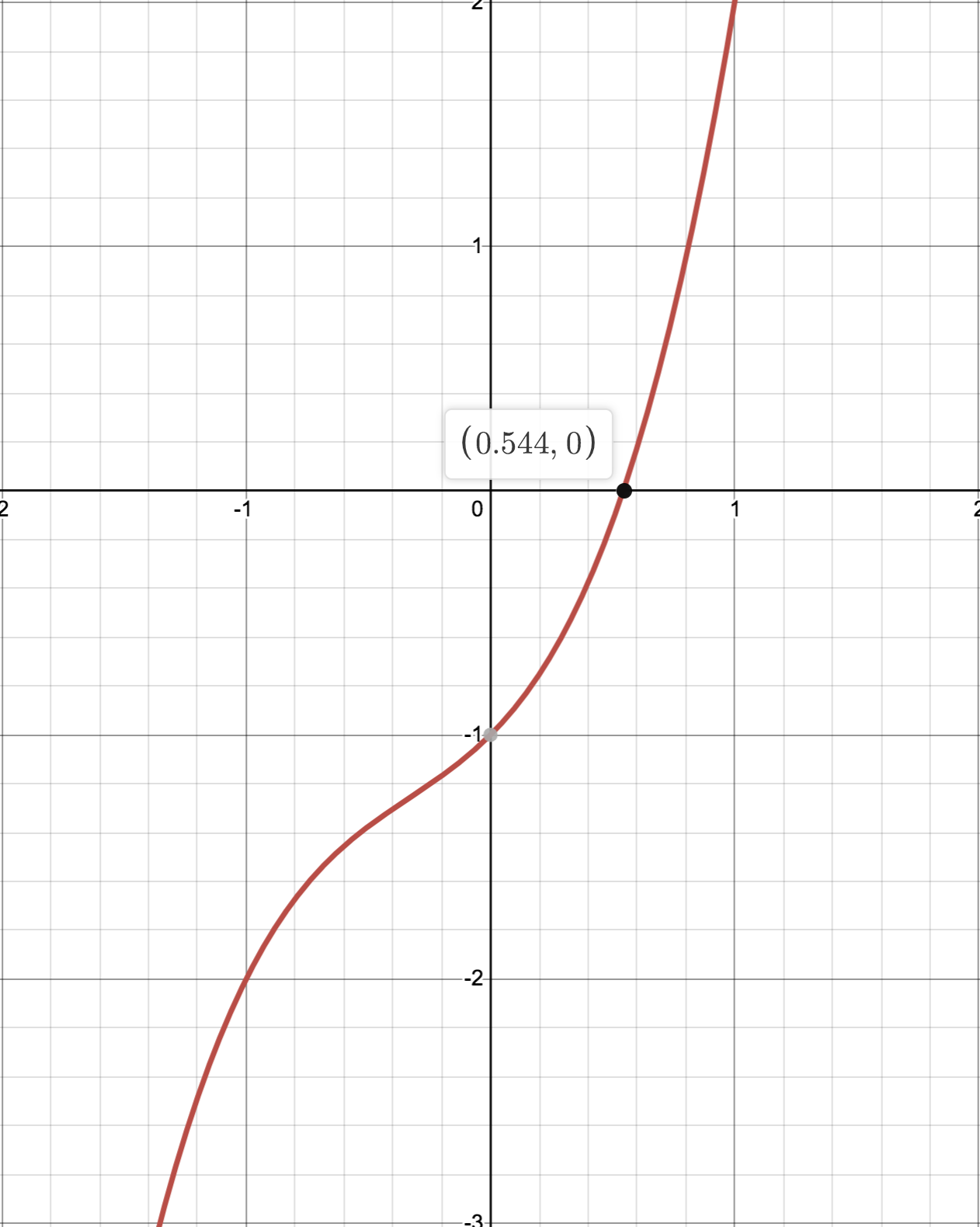
Following is the graph of y=x3+x2+x−1 (Desmos Link). As we can see, the real root is at x≈0.544
Let us check if it indeed is true using the first few terms, 1, 1, 2, 4, 7, 13, 24, 44, …
an−1
an
anan−1
1
1
1
1
2
0.5
2
4
0.5
4
7
0.571
7
13
0.538
13
24
0.542
24
44
0.545
44
81
0.543
81
149
0.544
We can indeed verify that it converges to 0.544.
General Solution for ‘k’th Order Fibonacci Ratio
The above solution need not be complex, as I had overlooked the fact that
Hence, x is the value for which this iteration converges:
x=∑i=0k−1xi1
It is the value of the real root of
xk+xk−1+xk−2+…+x−1=0
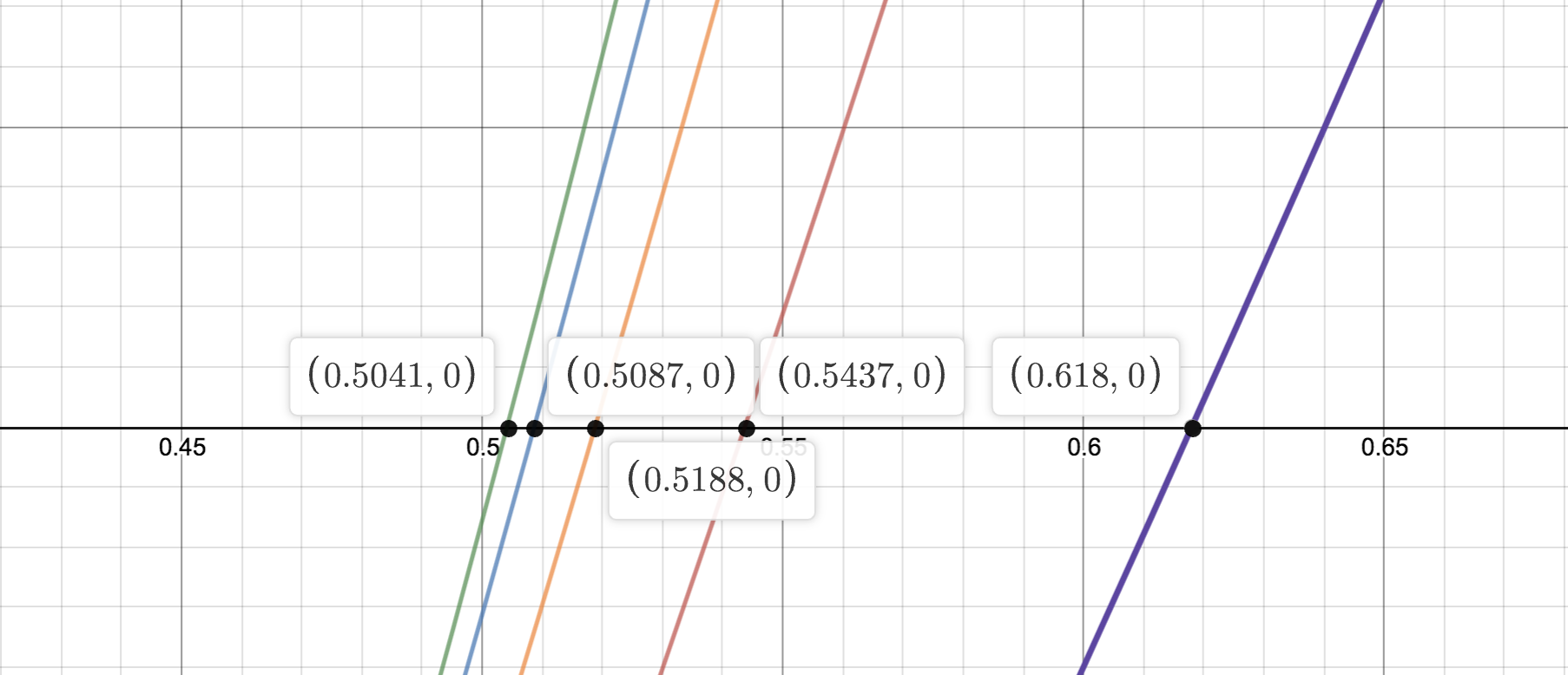
The following plot shows the roots for k=2 to k=6. It is interesting to observe that for k=2, the root is 1 over golden ratio ϕ1=2/(1+5)≈0.618. For k=∞, the root is 0.5.